
Transition Beyond Value-Mediation:
Why Socialism Cannot Be Owned Into Existence

Anthony Teso
I. The Frame
The transition question, when posed seriously, makes most socialist programs legible as one of two errors. Either capital is treated as a thing in the hands of a class and socialism becomes the redistribution of that thing through nationalization, expropriation, or worker ownership, or capital is treated as a personification, an individual or social type, and socialism becomes the abolition of that type while the relations that produced it continue to operate. Both errors share a logic in which capital is a substantive entity rather than a social form. Both produce political programs that fail in characteristic ways.
The market-socialist tradition makes the first error explicit. Whether in the academic form of Roemer’s coupon socialism[1] or Schweickart’s economic democracy,[2] or in the practical form of Yugoslav self-management and the Mondragon cooperatives, the move is to retain market coordination of enterprise activity while transforming the legal form of property. Workers’ names go on firms. The market remains the form of social mediation. The result, predictable in advance and confirmed by every historical case, is that the firms confront one another through competition, internalize the discipline of socially necessary labor time, generate hierarchies of skill and remuneration, and over time reproduce the dynamics of capital accumulation in cooperative clothing.[3]
The state-property tradition makes the second error. Capital is treated as the bourgeoisie, and the abolition of the bourgeoisie through expropriation by the workers’ state is treated as the abolition of capital. But if state-owned enterprises continue to produce commodities for exchange, compete for plan resources, organize labor through the wage form, and be evaluated against quantitative output targets that function as proxies for value, then capital has not been abolished. It has been reorganized. The Soviet experience is, in this analysis, not the betrayal of socialism by particular leaders but the consequence of a strategy that addressed ownership without addressing form.[4]
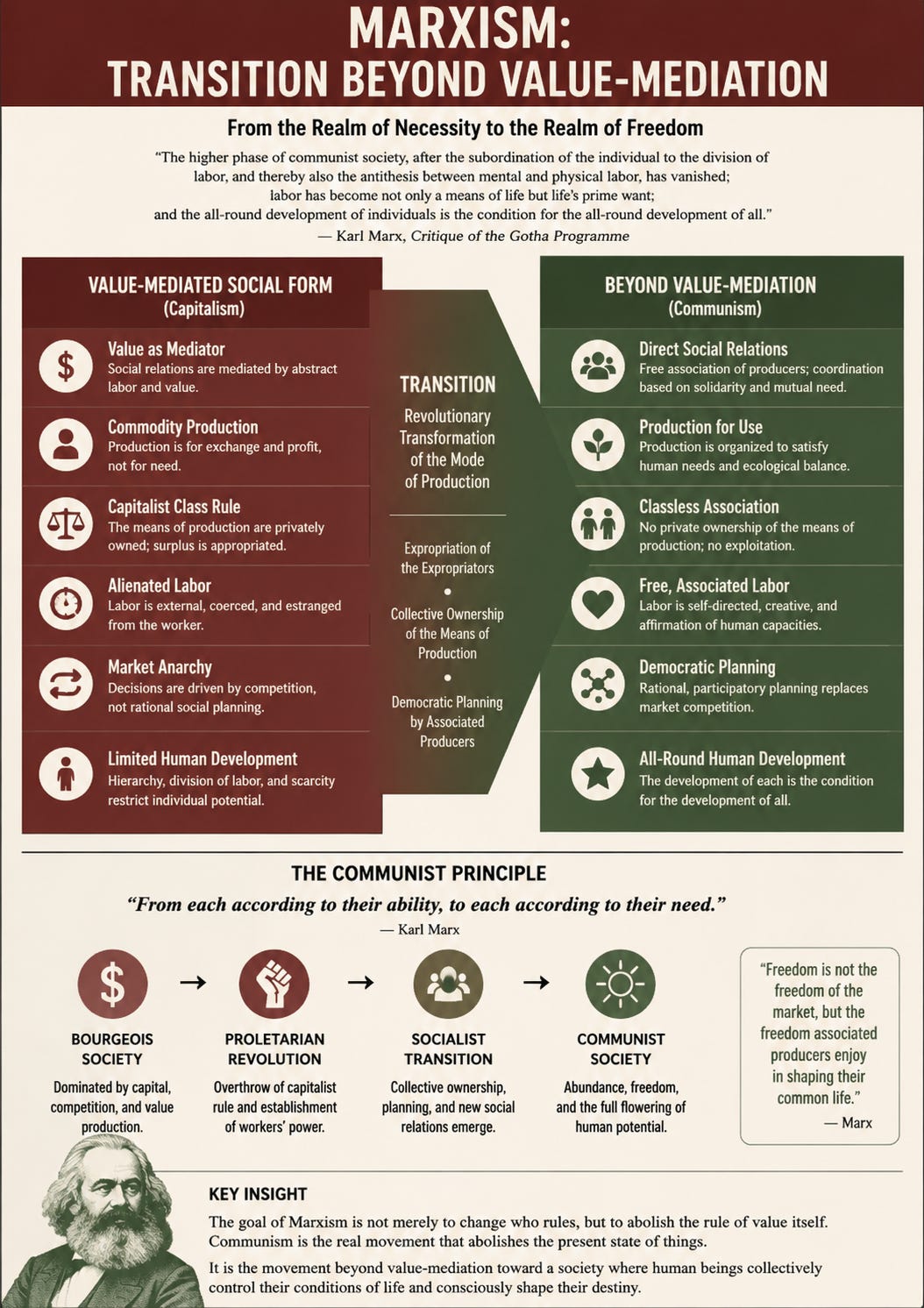
What is at stake in the transition question is therefore neither ownership nor management. It is the form labor takes, whether labor’s social character is established through retrospective exchange validation, behind the backs of producers, through the imposition of socially necessary labor time as compulsion, or whether labor’s social character is established prospectively, through conscious deliberation, by the associated producers determining together what is to be produced and how social labor is to be allocated.
This essay argues that social reproduction without value mediation from day one is possible, has been theorized concretely, and constitutes the only defensible content of the socialist transition. The argument proceeds in five steps. The first specifies what value-mediation is and why it cannot be reformed. The second identifies the tasks of social reproduction that any post-capitalist society must perform. The third surveys the existing models of non-value coordination and identifies what is load-bearing across them. The fourth addresses three serious difficulties: the temporal question of the lower phase, Postone’s challenge concerning abstract labor, and the calculation problem in its non-Misesian form. The fifth draws the strategic implications for socialist politics in the present conjuncture.
II. Value as Social Form
The argument turns on what value is, and the secondary literature obscures this as often as it clarifies. Value in Marx is not utility, not price, not labor cost, and not labor time as such. It is the form private labor takes when, under conditions of generalized commodity production, that labor’s social character must be established post-hoc through the validation of its products in exchange.[5] The producer does not know, while she works, whether her labor will count as social labor. The market discloses it retroactively by either validating the commodity through sale or refusing to do so. Socially necessary labor time is the standard imposed through this validation, and it is enforced as compulsion: the producer whose labor exceeds the social average is punished by losses, and the producer whose labor falls below it is rewarded with profits.
Value is therefore a form of social mediation. It is the form in which the social character of labor is established under capital. To say that capital is a social relation is to say that it is this form. The personal capitalist is incidental; what is essential is that labor’s social character must be established through exchange, that producers confront one another and society through commodities, and that the discipline of socially necessary labor time is imposed as objective compulsion rather than as conscious decision. The value-form school in its various branches — Backhaus and Reichelt’s Neue Marx-Lektüre, Heinrich’s reconstruction, Bonefeld’s open Marxism — has elaborated this reading in detail.[6] Its consequences for the transition question are direct.
Three consequences follow.
First, capital cannot be abolished by abolishing capitalists. The expropriation of the bourgeoisie, by itself, does not abolish the form of social mediation through which capital reproduces itself. If the new state-owned or worker-owned firms continue to produce commodities for exchange, to be coordinated through markets, and to discipline their labor processes against external compulsion, capital has not been abolished. It has changed its institutional clothing. The Bolshevik experience after the introduction of the New Economic Policy in 1921, and the longer Soviet trajectory after the consolidation of the planned economy in the 1930s, illustrate this in different ways: in the former, the explicit reintroduction of commodity production; in the latter, the persistence of value-form relations within and between state enterprises despite the formal absence of markets.[7]
Second, capital cannot be abolished by changing what counts as a commodity at the margin. Decommodifying healthcare or housing, while desirable in itself, does not, by itself, transcend value mediation if the bulk of production remains organized as commodity production. The social-democratic and market-socialist gesture of retaining commodity production for now while changing ownership or expanding the decommodified sector is therefore not a way station to transition but a stabilization of capital under new management.
Third, capital cannot be abolished by changing the units in which it is measured. Replacing money with labor vouchers does not by itself abolish value-mediation if the vouchers continue to function as money — that is, if they continue to mediate the social character of labor retroactively through exchange. Whether they do so depends not on the unit of accounting but on whether the social character of labor is established before or after production. This is the distinction that does the most work in this essay, and to which it returns in section six.
The point of these three consequences is not to refuse the institutional transformations they bracket but to refuse the claim that those transformations are by themselves sufficient. Worker ownership of firms is good. Decommodification of basic needs is good. Labor-time accounting may be necessary. The argument is that none of these, individually or together, constitutes a transition unless it is accompanied by the transformation of the form of social mediation itself, and that this transformation must begin from the start, because the alternative is to allow the form of capital to reassert itself through the gaps that the institutional changes leave open.
III. The Tasks of Social Reproduction
Any complex society, post-capitalist or otherwise, must perform a determinate set of reproductive tasks. The question of transition is whether these tasks can be performed without value mediation, and, if so, how.
The list is not exotic. Social labor must be allocated among productive activities: agriculture, industry, care, education, and infrastructure. Products or use-rights to them must be distributed among the population. Proportional balances must be determined: how much wheat is relative to barley; how much steel is for construction. Investment must be allocated intertemporally: how much present labor and resource use is to be devoted to expanding future productive capacity, and in what directions. Complex interdependencies in production must be coordinated, since the output of one activity is the input of another in a vast network of relations. Innovation must be managed, since technical change is constant and its direction is consequential. Labor-power must be reproduced, which is to say, the work of households, of care, of the rearing of new generations, must be performed and recognized. And the metabolism with nature must be managed, since human production is biophysical and ecological reproduction is the precondition of all social reproduction.[8]
Under capital, all of these are mediated through value. Labor allocation is mediated through wage competition. Distribution is mediated through money income. Proportional balance is mediated through profit-rate signals across sectors. Investment is mediated through capital flows seeking return. Coordination is mediated through market exchange. Innovation is mediated through competitive pressure that punishes laggards and rewards leaders. Labor-power’s reproduction is partly mediated through the wage and partly externalized to unpaid, gendered household labor. Ecological reproduction is largely externalized onto nature and future generations, internalized only when state regulation or social struggle forces partial cost recognition. Each of these mediations operates as compulsion behind the backs of the producers; each presents itself as natural law; each is, in fact, the specific form social activity takes under capital.
To say that transition means going beyond value-mediation from day one is to say that each of these tasks must, from the beginning, begin to be performed through different forms of social mediation. The deliberative, planned, federated forms that emerge will not be perfect, will not be uniform across sectors, and will not arrive whole. But the directional commitment — that labor’s social character is to be established prospectively, through conscious determination, rather than retroactively through exchange must be present from the start. The alternative is to defer the question to a later phase that in practice never arrives, because the unreformed value-form continues to do the work of social mediation in the interim, and that work tends to consolidate the conditions of its own continuation.
Marx’s own formulations point this way. In the first chapter of Capital, after the analysis of the commodity, he describes the inverted situation of an association of free producers who consciously regulate their labor in accordance with a settled plan, and in which the social character of labor is therefore transparent from the outset rather than concealed in the form of commodities.[9] In the third volume, in the discussion of the metabolism between humans and nature, the associated producers govern their interchange with nature rationally and in common, rather than being governed by it as a blind force.[10] In the Critique of the Gotha Programme, the distinction between the lower and higher phases of communist society turns ultimately on whether labor has yet ceased to be the measure of distribution.[11] The motion through these formulations is from external mediation to conscious determination. Whatever else is in dispute among Marxists, that motion is the content of the transition question.
The question, then, is not whether such conscious determination is possible in principle; Marx took this for granted, but whether it can be theorized concretely as a set of mechanisms adequate to the tasks of social reproduction enumerated above. The next section addresses that question directly.
IV. Models of Non-Value Coordination
The existing theoretical models of social reproduction without value-mediation are neither vague nor exclusively negative. Several are detailed and computationally serious. They differ in important ways, but they share a basic structure: labor’s social character is established through deliberation, planning, and federated decision-making rather than through retroactive market validation.
Cockshott and Cottrell propose direct labor-time accounting.[12] The plan is constructed in physical input-output terms, with labor time as the common unit of social cost. Modern computational capacity makes it possible to calculate a coherent plan for an economy of millions of products, contrary to the Misesian objection that calculation is intractable in principle. Consumer goods are distributed through labor vouchers, with each hour of labor performed yielding one labor-hour claim on the social product. The prices attached to consumer goods are not market prices; they are computed labor-content figures that play an informational role in plan revision but do not coordinate production through profit-seeking. Producers know in advance what they are to produce and for what purposes. The plan is revised iteratively in response to consumer demand patterns, but the revision is conscious, not retroactive. The strength of the Cockshott-Cottrell model is its computational seriousness; its weakness, as I argue below, is its tacit retention of labor time as the form of social mediation, which leaves it exposed to Postone’s challenge.
Albert and Hahnel propose participatory economics.[13] Workers’ councils and consumers’ councils negotiate iteratively through facilitation boards. Indicative social costs reflect labor, ecological, and other inputs but are not market prices, because they are not the outcome of exchange; they are inputs to deliberation. Remuneration is based on effort and sacrifice rather than contribution or skill, on the principle that contribution depends substantially on circumstances beyond individual control. Balanced job complexes distribute empowering and disempowering work among all workers, to prevent the reassertion of intra-workplace class hierarchy through the division between conceptual and executory labor.
Devine proposes negotiated coordination.[14] Decisions about investment and major productive change are made through multi-level negotiation among all affected parties: workers in the relevant industry, consumers, suppliers, communities in which production is located, environmental representatives, and broader social bodies. Markets for existing goods may persist in restricted form during the transition, but markets for capital, that is, for the determination of where new productive capacity is to be built, are abolished. The accumulation function passes from the market to deliberative bodies. The distinction between markets for consumption goods and markets for capital is crucial to Devine’s argument and bears on whether his model genuinely transcends value-mediation, a question I take up below.
The council-democratic traditions, drawing on early Soviet experience, the German revolution of 1918-1919, the operaista current of the 1960s and 1970s, and the various twentieth-century moments of workplace occupation and self-management, emphasize federated workers’ councils as the political and economic form of associated production.[15] Coordination emerges from the articulation of councils at successively higher levels of workplace, locality, region, and society rather than from central direction. The strength of this tradition is its insistence that the political form of socialism is not separate from its economic form, and that the form of the workers’ state must itself be a transformation of the bourgeois state-form rather than its inheritance. The weakness, frankly acknowledged, is its under-theorization of how council articulation actually solves the coordination problem at scale, a question that Devine’s approach takes more seriously and that any serious council-democratic model must integrate with the computational and deliberative tools that Cockshott and Albert-Hahnel respectively elaborate.
Hybrid models combine elements: free access for basic needs, labor-time accounting for goods involving meaningful individual variation in consumption, deliberative determination for major investment and collective consumption, and federated political structures for governance. The hybrid character is not eclectic but principled: different reproductive tasks call for different mediating forms, and the unity of transition lies not in a single mechanism but in the consistent directional commitment to conscious determination over retroactive validation.
What is load-bearing across these models, and what makes them genuine alternatives to market socialism rather than variants of it, is that labor’s social character is established through conscious determination rather than retroactive validation. Whether the quantification is centralized or dispersed, whether the unit is labor time or something more qualitative, whether the institutional form is more council-democratic or more deliberative-negotiated, the form of social mediation has changed. That change is the content of the value-form transition.
V. Three Difficulties
The argument so far would be too easy if it did not confront its serious difficulties. Three deserve direct treatment: the temporal question, Postone’s challenge, and the calculation problem in its serious form.
The temporal question. The Critique of the Gotha Programme distinguishes between a lower phase of communist society in which distribution is according to contribution, labor vouchers function as the medium of individual consumption claims, and the birthmarks of the old society persist, and a higher phase in which the distinction between mental and manual labor has dissolved, labor has become life’s prime want, and distribution proceeds according to need.[16] Most twentieth-century traditions treated this as a temporal sequence: lower phase first, higher phase later. The value-form tradition has tended to refuse or collapse the sequence, on the grounds that any persistence of commodity production, money, or value-mediated exchange in the lower phase creates the conditions for capital’s return.
The right move is neither acceptance nor refusal of the two-phase framework but its reformulation. What matters is not whether some quantification persists at the start, it must, for any complex social reproduction, but whether that quantification functions as social mediation in the strong sense. Labor vouchers that operate as direct individual consumption claims, redeemed against a plan whose magnitudes have been determined by deliberation, are not money in the value-form sense. They do not circulate as capital. They do not accumulate. They do not measure abstract labor through retroactive validation. They are administrative instruments of a planned distribution, and the labor whose hours they record has had its social character established in advance through the planning process.
Conversely, if labor vouchers function as money if they accumulate, if they are exchanged among enterprises to acquire productive inputs, if they circulate against goods whose production has been organized for sale, then they are money in everything but name, and the transition has not begun. The test is functional, not nominal. The Soviet case is instructive precisely because its formal vocabulary of planned production concealed practices in which enterprise success was measured against quantitative output targets that functioned as profit proxies, against which managers competed for resources, and through which the social character of labor was effectively established post-hoc rather than ex ante.[17]
Postone’s challenge. Postone’s reconstruction of the value-form critique deepens the analysis in a way that bears directly on labor-time accounting.[18] Value, on his reading, is not merely the form of social mediation but the temporal-abstract form of social domination characteristic of capital. Abstract labor — labor as the substance of value — is labor reduced to a homogeneous flow measured by socially necessary labor time, and this reduction is itself the form of capital’s domination of producers. The treadmill effect of productivity increases under capital, which raises output without proportionally reducing labor time, is the signature of this temporal domination.
The challenge to Cockshott-style labor-time accounting is sharp. If labor time is retained as the unit of social accounting in post-capitalist society, has the form of abstract-labor domination really been transcended? Or has it been preserved in a different institutional skin, with the planning agency replacing the market as the enforcer of socially necessary labor time?
Two responses are available, and the honest answer requires both. First, labor time as a unit of measurement is not the same thing as labor time as a form of social mediation. Capital’s domination operates because socially necessary labor time is imposed as compulsion through market competition, behind producers’ backs. Labor time as a tool of conscious planning, subject to political deliberation about its measurement, weight, and significance, does not have this form. The unit can persist while the form is transformed. Second, Postone’s challenge is correct as a horizon. The higher phase, in the Gotha Programme’s formulation, involves the supersession of labor as the measure of distribution and ultimately of social organization. The transition is not toward a permanent labor-time-accounting society but toward a society in which labor’s hold on the form of social life is progressively dissolved. The relevant questions concern the reduction of labor time, the transformation of the labor process, the decoupling of distribution from contribution, and the qualitative transformation of work itself. Labor-time accounting is a transitional form, not a destination.
The calculation problem in its serious form. The Misesian calculation argument has been answered too often to require rehearsal here.[19] The interesting version of the calculation problem is the Hayekian one: that markets aggregate dispersed, tacit, locally specific knowledge through prices in ways that no central or even federated planning body can replicate, because the relevant knowledge is constantly changing and resistant to centralization.[20]
The right response is neither denial nor concession. Markets do aggregate certain kinds of information through prices, but they do so by aggregating only the information that is expressible in the form of effective demand, which is to say, the information backed by purchasing power. They do not aggregate need; they aggregate ability to pay. They do not aggregate ecological costs; they aggregate only those costs that have been forced into the price form by regulation or social struggle. They do not aggregate intergenerational consequences. The knowledge that markets convey is therefore a specific and partial form of knowledge, structured by the social form of the market itself.
Deliberative and federated planning aggregates different information: stated need, expressed preference, ecological constraint, communal priority, and intertemporal commitment. Computation enables the integration of vast quantities of physical input-output data that markets do not require, but planners do. The relevant question is not whether planning aggregates information as well as markets do, but whether the kind of information it aggregates is better suited to social reproduction. The answer this essay submits is that it is on the condition that the political forms of deliberation are themselves adequate to the task.
This last condition is not trivial. The deliberative and federated forms must be real, not formal. The councils must possess actual decisional power, not be advisory bodies to a parallel state apparatus. The political form of transition must itself be transformed, which is to say that transition is simultaneously a question of the state form and the economic form. Either one without the other reproduces what it claims to overcome.
VI. The Clarifying Distinction and Strategic Implications
The argument turns, in the end, on a single distinction. Labor time as a unit of measurement is not the same thing as labor time as a form of social mediation. The same holds for any quantitative accounting in a complex society. The relevant question is not whether quantification persists, but whether that quantification functions as social mediation in the strong sense: whether it imposes its logic on producers through external compulsion or whether it serves as a tool of conscious determination subject to political deliberation.
This distinction holds against three common misreadings of the value-form position. It is not the claim that all quantification is bourgeois. It is not the claim that planning must be entirely qualitative or that scarcity does not exist. It is not the claim that the calculation problem can be ignored. It is the claim that the form of social mediation, the way labor’s social character is established, is what distinguishes capital from its supersession, and that supersession requires this form to change from the beginning of any serious transition.
The strategic implications follow. Decommodification of basic needs is not a soft reform; it is a step in the transformation of social form. The construction of federated political structures capable of conscious determination is not preparatory; it is constitutive. The struggle for workers’ control of production at the point of production is not merely a tactic but the development of the political subject and form of associated production. The political-organizational question and the transition question are not separable: the absence of disciplined revolutionary organization capable of articulating these forms is itself a structural barrier to transition, not a tactical detail.
This bears directly on the contemporary debates within the American socialist left. The Democratic Socialists of America’s strategy of electoral subordination to the Democratic Party, in the absence of mechanisms of parliamentary discipline analogous to those theorized by the Communist International in its first four congresses, treats transition as deferred to an unspecified future moment and addresses present politics in terms compatible with managing capital rather than transcending it. The market-socialist intuitions that often accompany this strategy, that worker-owned firms, expanded cooperative sectors, and decommodified social services together constitute socialism, reproduce in left form the conceptual error that the right makes when it equates capitalism with private property. Capital is a social form, not an ownership structure. Its supersession requires the transformation of that form, beginning now.
The transition question, posed seriously, is therefore not a question of when to start but of which direction to move in. The vector matters more than the velocity. Movement away from value-mediation, toward conscious determination of social labor by the associated producers, is the content of socialist transition. Movement toward refined market signals expanded cooperative ownership, or democratic management of accumulation is not. The first is the difficult, contested, but defensible content of a socialist program. The second is the management of capital by other means.
References
Albert, M., & Hahnel, R. (1991). The political economy of participatory economics. Princeton University Press.
Backhaus, H.-G. (1969). Zur Dialektik der Wertform. In A. Schmidt (Ed.), Beiträge zur marxistischen Erkenntnistheorie (pp. 128–152). Suhrkamp.
Bettelheim, C. (1976). Class struggles in the USSR: First period, 1917–1923 (B. Pearce, Trans.). Monthly Review Press.
Bonefeld, W. (2014). Critical theory and the critique of political economy: On subversion and negative reason. Bloomsbury.
Cockshott, W. P., & Cottrell, A. (1993). Towards a new socialism. Spokesman.
Devine, P. (1988). Democracy and economic planning: The political economy of a self-governing society. Polity Press.
Foster, J. B. (2000). Marx’s ecology: Materialism and nature. Monthly Review Press.
Hahnel, R. (2005). Economic justice and democracy: From competition to cooperation. Routledge.
Hayek, F. A. (1945). The use of knowledge in society. American Economic Review, 35(4), 519–530.
Heinrich, M. (2012). An introduction to the three volumes of Karl Marx’s Capital (A. Locascio, Trans.). Monthly Review Press.
Lebowitz, M. A. (2012). The contradictions of “real socialism”: The conductor and the conducted. Monthly Review Press.
Marx, K. (1976). Capital: A critique of political economy, Volume I (B. Fowkes, Trans.). Penguin. (Original work published 1867)
Marx, K. (1981). Capital: A critique of political economy, Volume III (D. Fernbach, Trans.). Penguin. (Original work published 1894)
Marx, K. (1989). Critique of the Gotha Programme. In Marx and Engels collected works (Vol. 24, pp. 75–99). International Publishers. (Original work published 1875)
Pannekoek, A. (2003). Workers’ councils. AK Press. (Original work published 1947)
Postone, M. (1993). Time, labor, and social domination: A reinterpretation of Marx’s critical theory. Cambridge University Press.
Roemer, J. E. (1994). A future for socialism. Harvard University Press.
Rubin, I. I. (1972). Essays on Marx’s theory of value (M. Samardžija & F. Perlman, Trans.). Black & Red. (Original work published 1928)
Schweickart, D. (2002). After capitalism. Rowman & Littlefield.
Ticktin, H. (1992). Origins of the crisis in the USSR: Essays on the political economy of a disintegrating system. M. E. Sharpe.
[1]Roemer (1994) elaborates the coupon socialism model, in which shares of public enterprises are distributed equally to citizens as inalienable coupons. The model retains capital markets in modified form and concedes that questions of productive coordination remain market mediated.
[2]Schweickart (2002) develops the economic democracy model, in which firms are worker-managed but compete in product markets, with social investment determined politically through a public banking system.
[3]Lebowitz (2012) analyzes the Yugoslav case in detail, demonstrating how self-management combined with market coordination reproduced inter-firm competition, regional inequality, unemployment, and the dynamics of capital accumulation under the formal absence of capitalist ownership.
[4]Bettelheim (1976) develops this argument, focusing on the persistence of commodity relations and value-form mediations within state-owned production. The earlier exchanges with Sweezy in the pages of Monthly Review remain instructive on whether the USSR exhibited a distinct mode of production or a deformed transition.
[5]Heinrich (2012) provides the most accessible elaboration of value as social form rather than as embodied substance. The position has antecedents in Rubin (1928/1972), whose recovery in the 1970s shaped the entire neue Marx-Lektüre.
[6]Bonefeld (2014) elaborates the open Marxist variant of this reading, emphasizing the constitution of value-form categories through class antagonism rather than their derivation as objective economic laws. Backhaus (1969) remains foundational for the neue Marx-Lektüre.
[7]Ticktin (1992) offers a useful analysis of the Soviet economy as a structure of waste, hoarding, and managerial competition that reproduced many of capital’s dynamics in distorted form, even where formal markets were absent.
[8]Foster (2000) elaborates Marx’s concept of the metabolic rift to situate ecological reproduction within Marx’s broader theory of social reproduction. The point is not that Marx was a proto environmentalist but that the metabolism with nature is a structural moment of any social formation.
[9]Marx (1867/1976), Chapter 1, Section 4, in the discussion of commodity fetishism, contains the well-known passage describing an association of free producers working with the means of production held in common and consciously regulating their labor.
[10]Marx (1894/1981), in the late discussion of the realm of freedom and the metabolism between humans and nature in Chapter 48.
[11]Marx (1875/1989), in the well-known passage distinguishing the two phases. The distinction is more provisional than the canonical reading often suggests; Marx is explicit that the lower phase still bears the birthmarks of the old society in every respect.
[12]Cockshott and Cottrell (1993). Their subsequent work has developed the computational and statistical foundations of the model in considerable detail; see in particular their treatment of the calculation problem in Chapter 3.
[13]Albert and Hahnel (1991). The model has been further elaborated in Hahnel (2005), which engages criticisms from market socialists and from the council-democratic tradition.
[14]Devine (1988). The model is distinctive in its careful theorization of the institutional forms of deliberation across multiple levels of social organization, and in its sharp distinction between markets for consumption goods and the abolition of capital markets.
[15]The literature on the council-democratic tradition is vast and contested. Pannekoek (1947/2003) and the Dutch German left communists developed the strongest theoretical statements; the operaista current, particularly through Panzieri and the early Quaderni Rossi, recovered and extended the analysis in the 1960s.
[16]Marx (1875/1989). The lower-phase formulation describes distribution proportional to labor contribution, mediated by labor certificates that are not money because they do not circulate.
[17]Ticktin (1992); see also Bettelheim (1976). The argument is not that the Soviet economy was capitalist in the same sense as Western economies, but that the failure to abolish the value-form left structural openings through which value-form dynamics reasserted themselves in distorted ways.
[18]Postone (1993), particularly Chapters 3 and 8. Postone’s political conclusions diverge sharply from those of this essay; his theoretical reconstruction of the value-form critique nonetheless retains its analytical force independent of those conclusions.
[19]See Cockshott and Cottrell (1993, Chapter 3) for the standard response, which demonstrates that the Misesian objection conflates the question of whether calculation is possible at all with the question of whether market prices are necessary for it. The first is empirically settled; the second is what Hayek defends.
[20]Hayek (1945). The Hayekian argument is more sophisticated than the Misesian one and has not been adequately answered within the socialist literature, which has tended to focus on the easier Misesian target. Devine (1988) engages it more directly than most.